
The situation of law enforcement in Chattogram is ‘worrying’, call for a coordinated effort
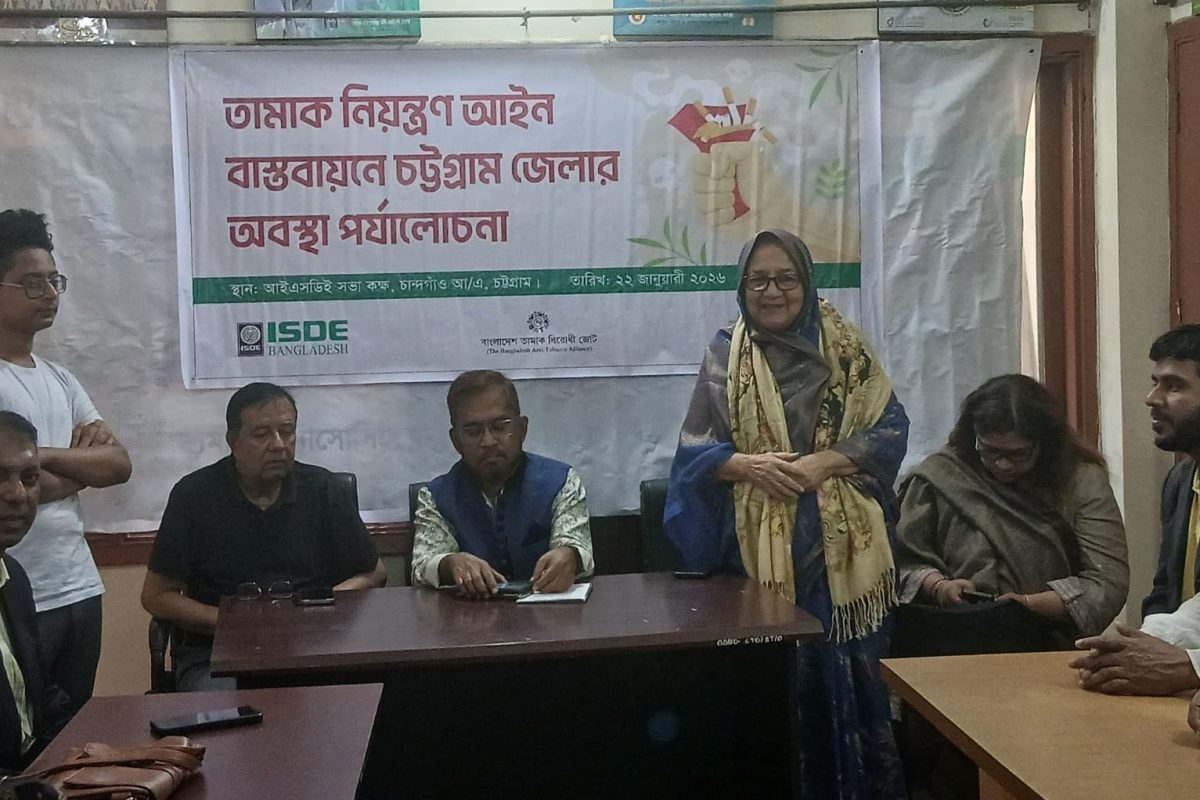
Discussion meeting was held to review the current situation of the implementation of the Tobacco Control Act in Chattogram district and to raise public awareness. The meeting took place on Wednesday (22 January 2026) at 11:30 am at the ISDE Bangladesh conference room in Chadgaon Residential Area, Chattogram. This sharing meeting, organized jointly by Bangladesh Anti-Tobacco Alliance, WBB Trust, ISDE, and ELLMA, was chaired by S M Nazer Hossain, Vice President of the CAB Central Committee and Executive Director of ISDE Bangladesh. Participants in the discussion included former President of Chattogram Journalists’ Union M. Nasirul Haque, Executive Director of ILMA Jesmin Sultana Paru, permanent member of Ziaur Rahman Foundation and prominent female leader Dr. Lucy Khan, staff reporter of Daily Purbodesh M.A. Hossain, staff reporter of Daily Amar Desh Osman Jahangir, Joint Secretary of the District Social Entrepreneurs’ Council Mohammad Jane Alam, Principal of Chandgaon Laboratory Public School and College Ismail Faruqi, and Joint Secretary of CAB Chattogram Metropolitan Mohammad Selim Jahangir, Jannatul Ferdous, Organizational Secretary of CAB Chittagong Metropolitan, Sayera Begum, Executive Director of Sabujer Jatra, ABM Humayun Kabir, President of CAB Pashchish Sholo City Ward, Abu Hanif Noman, President of Youth CAB Chittagong Metropolitan, youth CAB members Siratul Muntaha, Emdadul Islam, Nadim Abdullah, and others. The keynote paper was presented by ISDE intern Simon Islam at the meeting, which was chaired by ISDE Program Officer Raisul Islam.

At the meeting, Md. Simon Islam, Intern, ISDE Bangladesh, presented the district-based assessment report on the implementation of the tobacco control law and its violations. The report was jointly prepared by Work for a Better Bangladesh (WBIB) Trust and the Bangladesh Anti-Tobacco Alliance (BATA). It highlights the overall status of tobacco control law implementation based on data collected from 20 districts across the country in 2024.

The report mentions that Chattogram district scored only 16 percent out of 100 in implementing the tobacco control law, which is extremely concerning. According to the survey, in most districts, irregular meetings of the task force committee, failure to properly update health warnings, lack of no-smoking signage, absence of mobile courts, and weaknesses in controlling tobacco product advertising were clearly observed.

Moreover, the report also mentions that the absence of reliable and up-to-date statistics on tobacco users in any of the 20 districts included in the survey is creating significant limitations in adopting effective plans.
S M Nazer Hossain, Vice President of the CAB Central Committee and Executive Director of ISDE Bangladesh, said that the tobacco control law was enacted in Bangladesh nearly two decades ago. Although the ‘Smoking and Tobacco Products Usage (Control) Act’ was enacted in 2005 and subsequently amended in 2013 and 2015, the desired progress in its implementation has still not been achieved.

He further said, “The tobacco control law cannot function if it exists only on paper. Regular meetings of the task force committees at district and sub-district levels, market monitoring, conducting mobile courts, and enforcing fines are necessary to ensure visible implementation of the law.” He also mentioned that in practice, in most districts, task force meetings are not held regularly and the rate of conducting mobile courts is very low. Pointing out that despite the law prohibiting the sale of tobacco products within 100 meters of educational institutions and hospitals, it happens frequently in reality, he said this poses a severe threat to future generations. The lack of specific information on the sale of tobacco by children and to children is clear evidence of the weakness in law enforcement. Regarding revenue leakage, he said that tobacco companies are depriving the government of huge amounts of revenue by violating the maximum retail price (MRP). If proper monitoring and licensing systems are implemented, on one hand revenue collection will increase, and on the otherhand tobacco use will be discouraged.

Speakers said that tobacco control is not the responsibility of a single institution. Implementation of the law is impossible without coordinated efforts from the district administration, civil surgeon, Department of Consumer Rights Protection, local government institutions, and non-governmental organizations. He also commented that strengthening the tobacco control law and bringing institutions that violate the law under exemplary punishment is now a demand of the time for protecting public health.
From the meeting, several recommendations were presented emphasizing the need to further strengthen the tobacco control law, introduce a licensing system for tobacco sales, conduct regular market monitoring and mobile courts, ensure exemplary punishment for law violators, and increase widespread public awareness.